How to Pass ADI Tests?
Quick answer: To pass the ADI tests, focus on building strong foundational knowledge for Part 1, demonstrating advanced driving skills for Part 2, and mastering client-centred teaching techniques for Part 3. Consistent practice, self-reflection, and understanding what examiners look for at each stage of the ADI tests are key to success.
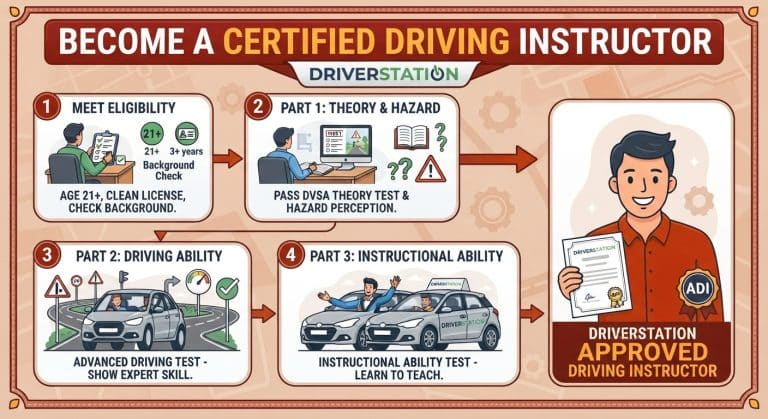
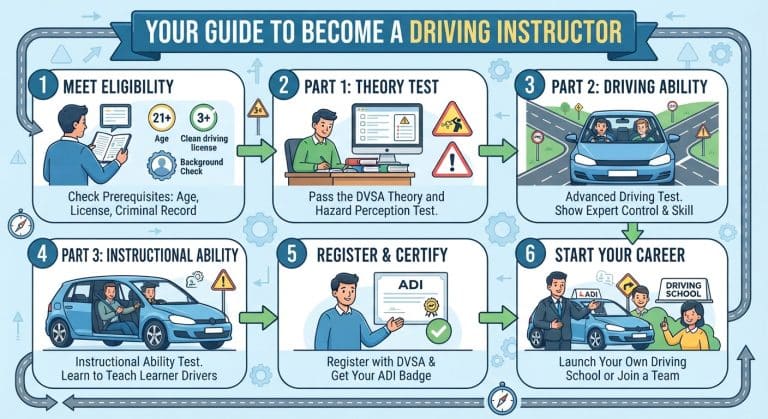
Becoming an Approved Driving Instructor is a rewarding career path, but also a demanding qualification process. The three parts of the ADI test are designed to assess very different skills: knowledge, driving ability, and instructional competence.
While the process can feel daunting and the pass rate is considerably low, the truth is that thousands of people pass every year. With the right approach and a clear understanding of what examiners want to see, you can give yourself the best possible chance of success. This guide breaks down each stage, offering practical strategies, common pitfalls to avoid, and the mindset you need to succeed.
Understand What the ADI Tests Are Really Assessing
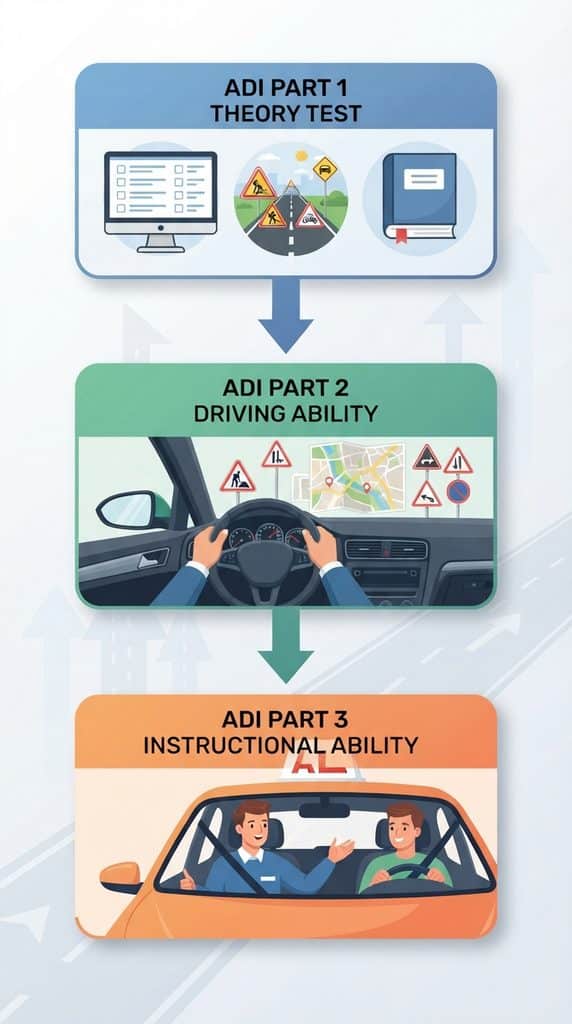
Before diving into each part, it helps to understand the bigger picture. The DVSA’s three-stage qualification process isn’t simply about ticking boxes; it’s designed to ensure you’ll be a safe, knowledgeable, and effective instructor once you’re qualified.
|
ADI Test |
What It Tests |
Focus Area |
Top Tip |
|---|---|---|---|
|
Part 1 |
Knowledge & hazard perception |
Driving rules, theory, and principles |
Study consistently and apply knowledge in context |
|
Part 2 |
Driving ability |
Advanced driving skills |
Drive like a professional, not a candidate |
|
Part 3 |
Instructional ability |
Coaching & communication |
Use client-centred teaching and reflective practice |
Think of it as building a house: Part 1 lays the foundation, Part 2 is the structure, and Part 3 is the interior that makes it work.
You can find the DVSA full guide on Become a car driving instructor: step by step
How to Pass the ADI Tests Part 1: Theory Test
The ADI Part 1 test is often underestimated, but it’s the cornerstone of everything that follows. It tests both your knowledge of road safety and instructional theory and your ability to recognise developing hazards.
What Does ADI Part 1 Involve?
- Multiple-choice questions: 100 questions across four categories. Pass mark: 85 overall, with at least 20 in each section.
- Hazard perception test: 14 video clips featuring developing hazards. Pass mark: 57 out of 75.
Both sections must be passed in the same sitting.
How Should I Study for ADI Part 1?
- Study little and often: Short, focused daily sessions are far more effective than cramming the night before.
- Use real-world examples: Connect what you learn with what you see on the road. For example, if you come across stopping distances, think about them next time you’re driving.
- Mix up your resources: Use DVSA materials, apps, and question banks from multiple providers to prepare for how questions are worded differently.
- Test yourself frequently: Mock tests are your best friend. They highlight weak areas early.
- Revise instructional theory too: Don’t ignore questions on teaching techniques and learner psychology, they’re important for other stages.
How to Improve Your Hazard Perception Score
Hazard perception isn’t guesswork; it’s about timing. You’re looking for developing hazards. Imagine real-life situations that require you to change speed or direction.
- Practise regularly: The more clips you watch, the better you’ll understand the timing.
- Click at the right time: When you first notice a hazard developing, wait a second or two before clicking. Clicking too early can cost you marks.
- Avoid over-clicking: Rapid, repeated clicks may register as “cheating” and score zero.
Common Mistakes in ADI Part 1
- Cramming last-minute: Leads to shallow understanding and poor retention.
- Neglecting teaching theory: Many candidates focus only on rules, but teaching knowledge is just as important.
- Clicking too often in hazard clips: This can result in a score of zero for that clip.
- Not managing time: 100 questions can feel long; pace yourself, and if you flag any, then review flagged questions.
You can find the DVSA guide on the Part 1 Test
How to Pass the ADI Tests Part 2: Driving Ability Test
The Part 2 test assesses whether your own driving is up to professional standards. It’s not enough to be “good,” you must demonstrate consistency, control, and forward planning.
What Does ADI Part 2 Involve?
- Eyesight check: reading a number plate at 26.5 metres
- Vehicle safety questions: 2 show me and 3 tell me questions
- Driving assessment: around 60 minutes on various roads
- Manoeuvres: two manoeuvres out of: forward bay parking, reverse bay parking, parallel parking, and pull up on the right-hand side and reverse back.
- Independent driving: 20 minutes of following signs or sat nav
- Emergency stop: a possibility
You can have up to six driving faults. Seven or more, or any serious/dangerous fault, is an automatic failure.
How Can I Prepare for ADI Part 2?
- Practise commentary driving: Talk through your decisions aloud. This builds anticipation and helps identify potential hazards early.
- Polish your driving habits: Eliminate bad habits like late mirror checks or wrong positioning.
- Plan ahead: Always look well ahead and anticipate potential hazards. This shows examiners you’re proactive, not reactive.
- Drive smoothly and confidently: Consistency is key. Every manoeuvre should look deliberate and controlled.
- Practise in varied conditions: City, rural, dual carriageways, and motorways. The more variety you cover, the more adaptable you’ll be on test day.
How Do I Manage Nerves on Test Day?
- Arrive early so you’re not rushed.
- Treat the drive as a demonstration, not a test.
- Focus on the road ahead, not the examiner’s actions.
- If you make a small mistake, keep going; it may not be serious.
Common Mistakes in ADI Part 2
- Underestimating the standard: It’s higher than a standard driving test.
- Poor observation: Missed mirror checks or poor hazard anticipation.
- Inconsistent planning: Reacting too late rather than planning ahead.
- Letting nerves take over: A calm, methodical approach is crucial.
You can find the DVSA guide on the Part 2 Test
How to Pass the ADI Tests Part 3: Instructional Ability Test
Part 3 is where everything comes together. It tests whether you can deliver safe, structured, and effective driving lessons. This is less about your own driving and more about how well you help someone else improve theirs.
What Does ADI Part 3 Involve?
- Delivering a real driving lesson to a real learner. DVSA refers to this as 40 40-minute wheel moving assessment.
- Being observed by a DVSA examiner in the back seat.
- Assessment across 17 competencies in three categories: Lesson planning, Risk management, and Teaching and learning strategies
How Can I Succeed in ADI Part 3?
- Plan lessons around the learner: Tailor content to their current level and goals.
- Use a client-centred approach: Adapt your teaching style to suit the learner’s needs.
- Ask guiding questions: Encourage learners to reflect and problem-solve rather than simply following instructions.
- Encourage reflection throughout: Brief pauses for discussion help reinforce learning.
- Stay calm under pressure: Mistakes are part of learning. How you manage them matters more than the mistake itself.
How Should I Handle Learner Mistakes?
Mistakes are inevitable. What examiners want to see is that you can:
- Maintain safety immediately (take control if needed).
- Analyse what happened and why.
- Use the incident as a teaching opportunity.
- Involve the learner in finding solutions.
For example: instead of you did this and do this next time:
“What did you notice about that junction? How could we approach it differently next time?”
You are now coaching.
Why Client-Centred Teaching Is Essential
The DVSA places strong emphasis on client-centred approaches because they reflect modern best practice. Instead of instructing learners what to do, you guide them to understand “why”. This builds safer, more independent drivers.
This approach also shows the examiner that you can adapt to different learners, a key skill for any instructor.
Common Mistakes in ADI Part 3
- Talking too much: Over-instruction instead of guiding the learner.
- Not adapting to the learner: Using a one-size-fits-all approach. Or sticking to your plan rather than changing it to suit the learner.
- Ignoring client-centred learning: Failing to ask reflective questions.
- Panicking after mistakes: Losing structure instead of turning errors into learning opportunities.
Build Confidence Through Reflection and Feedback
One of the most powerful ways to improve across all three parts is through reflection. Reflective practice turns mistakes into learning opportunities and helps you track your progress.
How Can Reflection Help Me Pass?
- Keep a training journal: After each session, write down what went well and what you’d do differently.
- Review DVSA marking criteria: Understand how each competency is assessed and check yourself against them.
Reflection builds confidence because it shows you how far you’ve come and where you still need to focus.
Train for the Job, Not Just the Tests
The ADI qualification process isn’t just about passing exams; it’s about preparing for the realities of the job. If you focus only on the tests, you might pass, but if you train with teaching in mind, you’ll pass and thrive.
Approach your preparation with real learners in mind. Think about how you’d explain concepts to someone nervous, how you’d adapt your style to different personalities, and how you’d maintain safety in unpredictable situations. That mindset will naturally shine through in your tests.
You can find the DVSA guide on the Part 3 Test
Final Thoughts
Passing all three parts of the ADI qualification is challenging, but with the right mindset and preparation, it’s entirely achievable. Remember:
- Part 1 is about understanding, building strong knowledge, and hazard perception skills. Study consistently, practise hazard perception, and cover instructional theory.
- Part 2 is about demonstrating, driving consistently, planning ahead, and showing professional standards. Polish your driving habits, anticipate hazards early, and stay calm on test day.
- Part 3 is about communicating, teaching effectively, adapting to the learner, and staying calm under pressure. Focus on client-centred teaching, reflective learning, and structured lesson planning.